

How as-a-Service (aaS) Can Help Your Business Grow

The Australian real estate market has undergone enormous technological change in the past 20 years. Whilst much of this has been driven by how customers prefer to consume information (think: online property search versus newspaper ads), agents are increasingly recognising the benefits new technology such as cloud services can provide these benefits, not just to marketing and customer relations, but also business systems and processes.

Many sales agents and property managers spend a lot of time in the field. Information is gathered, but can’t be actioned until they return to the office. Cloud services can solve this challenge by providing access to systems as and where your company needs them. Once regarded as a buzzword for technology geeks, cloud services now play a vital role across all operational areas in almost every industry including real estate, where they support sales administration, property management, trust accounting and more.

Cloud services are essentially subscription-based systems accessed via the Internet, rather than running directly off your computer or server.  Commonly known by the acronym aaS (as-a-Service), they are hosted remotely by a company, like a managed service provider (MSP) who stores, manages and supports your IT function using their own infrastructure and applications. Think of it as your own IT department or manager, but without the overheads!

You may have heard of some acronyms based on this concept, like IaaS (Infrastructure as a Service), PaaS (Platform as a Service) and SaaS (Software as a Service). These are just some of the many cloud-based services available today, but for now let’s explore the broader aaS concept, how it differs from on-premise IT solutions and how it can support your real estate business. We’ll save exploring these other acronyms for another article!

Prior to the introduction of aaS, the traditional approach to IT management has been to purchase, install and maintain systems on-site. This gives the business owner a high level of control, however it also requires significant upfront capital and ongoing upgrade costs, puts extra demand on staff resources and depends heavily on reliably powered, internet-connected and physically secure facilities.

It’s important to note that cloud technology is not a passing trend; it’s here to stay, and has been around for some time. We use it every day, often without realising, when we access services like Gmail or social media platforms. So when it comes to improving business systems and processes, cloud services are not so much a revolution, but an expansion of the benefits we already enjoy.

So how exactly does as-a-Service help your real estate business? Here are some key benefits to consider:

  1. Innovation and Expertise – Agility is a cornerstone of success in today’s business, and real estate is no exception. aaS enables you to be an innovator, integrating the latest system functionality immediately it becomes available without taking your staff away from higher priority tasks. Installations, maintenance and upgrades are managed by your MSP, eliminating the frustration and delay of system downtime and outages. You get continuous, expert support without the need for in-house IT resources. Your MSP also has access to highly sophisticated infrastructure security, and can provide a level of protection that for most in-house IT systems would be cost-prohibitive.
  2. Flexibility and Scalability – Even with the best reporting and projection capabilities, it can be challenging to anticipate when, where and how systems will be needed. Rather than purchasing a system or systems outright that might not be fully utilised, aaS provides optimal efficiency through subscription-based access to systems owned by the MSP. You only pay for what you need, and systems can be quickly scaled up or down as required – making them more cost effective and responsive to operational shifts like a growing sales team, new marketing activities and changes to financial reporting. By keeping operational costs down, aaS allows more capital to be channelled into helping your business grow. And by utilising infrastructure already in place in the cloud, it also enables you to trial new products at minimal expense.

Cloud based technologies such as aaS can benefit real estate operations in numerous ways. Whilst physical systems can meet many day-to-day operational needs, the pace of technological change, cost pressures and changing market demands can make it difficult to remain competitive. With the expert support of an MSP, business owners can leverage the time, cost and resource efficiencies of as-a-Service to remain agile and grow their real estate franchise.

If change and meeting your customers’ needs is a constant, doing nothing isn’t an option.  Be sure you are partnering with a company with the depth and breadth of expertise you require. Particularly one who can help you navigate end-to-end managed services, cloud, mobile and paperless office technology. GPK consultant, Ben Holian, is available for a no obligation discussion on how GPK can help you reduce operational costs, manage your IT footprint more effectively and create an exceptional experience for your customers. Contact: Phone 1300 000 475 or email info@gpkgroup.com.au for more information.
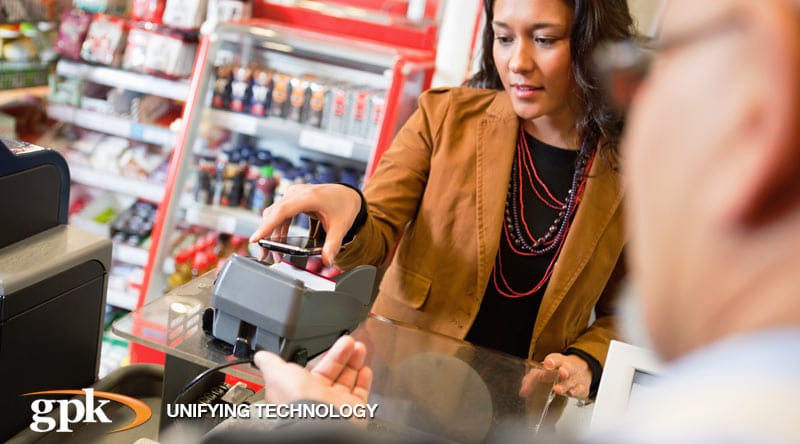
3 Key Benefits of Mobile Payments

Today’s retailer faces a rate of change that is unprecedented. Franchises and independent stores vie for the business of increasingly tech savvy and time poor consumers. At the same time, storeowners and managers must stay abreast of local and international trends in order to compete in a global marketplace.

Maintaining a competitive advantage in today’s marketplace demands innovation. One of the best, yet largely untapped opportunities for retailers to boost operational efficiency and create a point of difference with their customer is at point of sale (POS).

Checkout is a pivotal part of your business. For business owners and managers, a smooth POS process means more transactions, better utilisation of staff resources and greater security. For customers it means convenience, efficiency and peace of mind.

So how can you provide a seamless solution for both store and customer? The answer lies in your customer’s pocket.

Most of us are familiar with contactless payment or ‘Tap and Go’ facilities, where a transaction is completed without pressing buttons or entering a PIN. These generally involve the customer waving a credit or smart card over the point of sale scanner, which reads a chip inside the card in order to processes the transaction. This card technology is quick and convenient, but it’s limited to small transactions, can expose traders and customers to fraud due to lack of authentication and requires close proximity between the card and scanner.

Thanks to smartphone technology, there’s now a better way – mobile payments.

Apple and Google, the two biggest players in today’s smartphone marketplace each have a mobile payment and digital wallet system that leverages cellular and WiFi technology to deliver a smooth, highly secure and convenient point of sale experience. Both ApplePay and Android Pay systems are user-friendly, allowing customers to make payments as easily as they would with a ‘tap and go’ card by simply holding their phone over the point of sale scanner.

More and more consumers are opting to carry their smartphone instead of traditional cards and cash, especially Millennials, for whom smartphone technology is as essential as breathing! According to a 2017 study, they are 16 times more likely to use a digital wallet than their Baby Boomer grandparents, and also more likely to vote with their feet if a retailer doesn’t include this in their payment options.

Smartphone technology alone is not enough to create an advantage in Australia’s highly competitive retail marketplace. But stores that deliver greater convenience and efficiency and make it easier to buy by expanding their service to include new technologies like mobile payment are increasingly winning the war for customers. International research predicts mobile payments will contribute over $1 trillion in worldwide retail sales by the end of 2017.

Contactless POS options including ‘tap and go’ cards and mobile payments also encourage customers to spend more, simply due the ease of transactions. Studies into purchase behaviour following the introduction of ‘tap and go’ cards have shown overall spend to be universally higher, in some cases by as much as 30%, regardless of previous spending habits.

Mobile payment systems can be readily integrated into any POS system that already has a contactless payment facility and reliable mobile connectivity. But mobile payments also have several other benefits beyond those of traditional card-based contactless payment systems that add value to your current service offering. These include:

  1. Speed – In an age where every second a customer is kept waiting can cost you a sale, the speed of processing offered by mobile payments provides a small but compelling advantage, cutting several seconds off transaction processing time.
  2. Security – Mobile payments provide a security buffer between your point of sale system and the customer’s credit or debit card, greatly reducing the risk of card fraud. Both ApplePay and Android Pay employ sophisticated encryption and identification technology that allows payment authorisation without revealing the customer’s account details. Even if your POS system is affected by malware, the customer’s payment information stays safe.
  3. Flexibility – Mobile payment technology can also be integrated with other point of sale functions such as loyalty programs. This allows transaction information to be shared across systems, resulting in more meaningful behavioural data to assist operational decision making.

As competition in Australia’s retail marketplace intensifies, companies are increasingly looking to technology to help optimise business systems and processes, lower costs and increase sales. And today, there is a fourth crucial element to retail success: the customer.

Mobile payments are still a relatively new concept for many retailers and consumers, but the desire for a user-friendly, secure and efficient point of sale experience is universal. Partnering with a POS expert who can help you innovate by incorporating these new technologies into your existing service will not only create a more customer-centric experience and make them more likely to buy from you, but also differentiate you from competitors and help you achieve greater operational efficiency.

If change and meeting your customers’ needs is a constant, doing nothing isn’t an option. Be sure you are partnering with a company with the depth and breadth of expertise you require. Particularly one who can help you navigate end-to-end managed services, cloud, mobile and paperless retail technology. GPK Retail consultant, Cordell Quaine, is available for a no obligation discussion on how GPK can help you reduce operational costs, manage your IT footprint more effectively and create an exceptional experience for your customers. Contact: Phone 1300 000 475 or email info@gpkretail.com.au for more information.

8 Critical Success Factors to an Effective Strategic Partnership

At no point in history has it become more important to understand the phrase, “stick to your knitting.” Although in a rapidly changing world, doing the same thing better won’t necessarily help. Consequently, what ‘knitting’ should you focus on and how might you source the necessary ‘knitting’ capabilities needed? In this editorial we’ll provide you a framework that allows you to develop an approach to understand your motivations and the necessary partnership structures to develop successful outcomes.

There’s only so much time available, personnel and capital to pay them, let alone invest in growth! Resources are limited, however, knowing where and how to invest these resources is becoming increasingly difficult for business success. Wouldn’t it be wonderful if we had a crystal ball to see through complexity? One of the drivers of complexity is the increasing pace of change and fragmentation driven by technological innovations. To illustrate, Gartner and ChiefMartech demonstrate the number of technology companies developing marketing software exploded from under 200 in 2011 to approx. 4,000 in 2016. This explosion causes more complexity; what’s the right technology to acquire, how should it be managed and what constitutes success? Answering these questions impacts your ability to compete because as CIO Magazine state, “most companies don’t have the employees available to manage the emerging technology platforms” of paperless and always connected, mobile and cloud enabled systems. This challenge characterises the independent retail channel situation. The holy grail is a partnership structured across end-to-end customer touchpoints, via technology and domain expertise.

Deloitte explains, companies partner to seek cost savings, enable core business functions, and solve capacity issues with leading practice organizations to drive transformational change and improve business results. This leads to various partnering options.

The need to partner has three motivational dimensions.  First, there’s the transactional need for a resource; the exchange of product/services for cash. Second, co-ordination, the sharing and exchange of information to improve the coordination and synchronisation of key processes. Finally, collaboration, the exchange of information and knowledge amongst partners to deliver new or enhanced products and services to customers.

There are different partnership structures, with the main objective being the need to establish the level of control and flexibility for the partnership. This consists of two options; First, loosely coupled (suitable if risk is low) allowing the organisation to attract more business partners, creating partnering flexibility whilst enabling realisation of niche players’ capability. The second being tightly coupled (suitable if risk is high.) This allows for tightly defined relationships with a focus on solution quality and scale rather than pure speed to market. However, this does increase switching costs.

According to Harvard Business Review, Accenture and our own experience, a successful partnership has 8 specific critical success factors.

  1. Strategic alignment: The context is understood and supported.
  2. Collaborative governance: Adopting a partnership attitude with dedicated organisation.
  3. End-to-end approach: A holistic approach to managing the relationship scope.
  4. Business outcomes: Targeting strategic outcomes not just efficient transactions.
  5. Relationship between partners: Fostered through common culture and trust.
  6. Value beyond cost: Focusing on win-win benefits beyond cost reduction.
  7. Technology as a business enabler: Low cost and high value, driving operational improvements and innovation.
  8. Domain expertise and analytics: Contextualising data to create business value.

In GPK Retail business consultant, Cordell Quaine’s words, “providing value through understanding business outcomes is critical to our customer’s success. GPK isn’t a technology reseller or an outsourcer in the finer sense of the words, GPK is a solutions company focusing on establishing long-term coordinated and collaborative partnerships with technology as an enabler. We know our client’s success is our life blood, we endeavor to ensure the companies we represent have the technological edge over their competition. Our customers have access to a broad range of solutions including Merlin™ retail software, managed services, help desk and onsite support, ‘as-a-service’ private and public cloud infrastructure and software platforms, networking, hosted services, phone systems and SIP, security systems, web development, internet services (from NBN™ to ADSL to Wireless) and retail business technology consulting.” 

If change and meeting your customers’ needs is a constant, doing nothing isn’t an option.  Be sure you are partnering with a company with the depth and breadth of expertise you require. Particularly one who can help you navigate end-to-end managed services, cloud, mobile and paperless retail technology.  GPK Retail consultant, Cordell Quaine, is available for a no obligation discussion on how GPK can help you reduce operational costs, manage your IT footprint more effectively and create an exceptional experience for your customers. Contact: Phone 1300 000 475 or email info@gpkretail.com.au for more information.

This article first appeared in the May 2017 issue of MGA’s Independent Retailers magazine.

0%