

Public Cloud: The Good, the Bad and the Untrue

Internationally speaking, Australian business is considered ahead of the curve in our adoption of commercial cloud services. ABS research indicates that since 2014, the number of businesses using this technology has more than doubled. In many cases, however, this adoption is only skin deep. So, what’s holding us back in leveraging the capability of this growing technology?

We’ve talked before about some of the big benefits of integrating cloud services into your business. Scalability, cost efficiency, high availability, and uptime are advantages that need no further explanation. But there are other less visible benefits. There are also a few myths and confusion around how the cloud – and in particular, public cloud – really works.

Few business owners would disagree that today, agility is the name of the game. Cloud-based services meet this need head-on: services are available on an as-needed basis, enabling companies to pivot and innovate easier and faster, whilst optimising expenditure and staff resources.

Companies that resist or limit the implementation of cloud-based services cite a range of reasons. These include:

  1. Having to learn and maintain new tools

As with anything new, it takes a little while to adapt and learn the technology, but the learning curve is not as steep as you might think. In reality, most of us have been using cloud services in one form or another for more than a decade. And the majority of cloud services providers are only too happy to provide support! Maintenance is also faster, cheaper and simpler; your service provider becomes your remote IT team, keeping software and hardware updated, your system secure and eliminating the need for big-ticket asset purchases.

Moving away from static IT systems and adopting a cloud mentality allows companies to progressively build efficiency and scalability into their business. It lays the foundation for easily adding micro-services: sometimes an extra module or app is all that’s needed to take your business to the next level.

It also enables you to leverage the benefits of multiple public clouds. Today’s companies have a growing and diverse range of needs which require specialist service providers – so whilst it’s possible to use just one, your business will benefit more from using several providers, each with a richer level of expertise.

  1. Concerns about data sovereignty

Many business owners are already embracing the global marketplace. However, when it comes to the security and integrity of their data some worry that placing it in the public cloud and in particular, offshore storage and management, means handing over a little too much control.

These concerns are largely unfounded, as public cloud vendors must adhere to strict compliance regulations. They also utilise leading edge security tools and personnel to guard against hackers and other threats the average IT team would struggle to stay ahead of. Yes, the threats exist – but putting your data in the hands of an expert gives your business the best protection available.

This is not to say all responsibility rests on the shoulders of your cloud services vendor: companies should familiarise themselves with the international compliance laws and regulations in any country that houses their data. However, by doing their homework on the cloud services vendor engaged and putting a clear Service Level Agreement in place, business owners can guard against any unexpected breaches. And with migration tools now making it far simpler to change public cloud providers, they needn’t feel locked in if circumstances change.

  1. Heavy reliance on internet connectivity and speed

Moving your business to the public cloud does place a high reliance on your internet service to handle the workload. However, there are several steps your in-house IT team or managed service provider can take to optimise your network – including data prioritisation and WAN management – to ensure everyone has access to the data they need when they need it.

You might also like to consider a hybrid cloud solution such as Windows Azure, whereby some data is stored in the cloud and some at your site.

Along with these technical considerations, it’s also vital to review your ISP (Internet Service Provider) and implement a Service Level Agreement (SLA) to ensure a smooth transition and certainty around speed and connectivity.

Australian businesses are already benefiting from some of the best-known attributes of cloud-based services including cost efficiency, scalability, high uptime and security. Yet many hold back from fully leveraging its capabilities, fearing a loss of control or opening the door to compliance and security breaches. Nothing could be further from the truth. The public cloud is not without its risks – but the same can be said for any area of internet-based technology! Success in Australia’s competitive marketplace demands a cloud mentality – so explore your options. Today’s cloud services providers offer a plethora of specialised, secure and flexible options designed to help you grow your business.

If change and meeting your customers’ needs is a constant, doing nothing isn’t an option. Be sure you are partnering with a company with the depth and breadth of expertise you require. Particularly one who can help you navigate end-to-end managed services, cloud, mobile and paperless office technology. GPK consultant, Ben Holian, is available for a no obligation discussion on how GPK can help you reduce operational costs, manage your IT footprint more effectively and create an exceptional experience for your customers. Contact: Phone 1300 000 475 or email info@gpkgroup.com.au for more information.
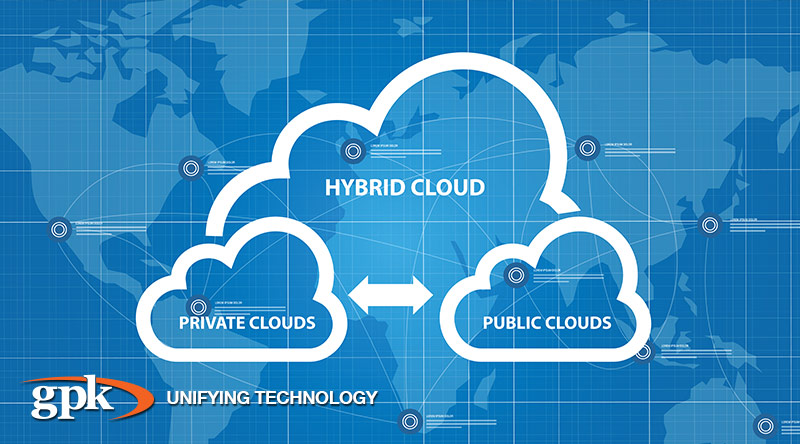

Public, Private or Hybrid – Which Cloud Is Right For You?

Though there is some debate over its origins and inventor, there’s no denying the extraordinary impact cloud technology has had on the way we do business. Companies of all sizes, across all industries, leverage its capabilities daily, to reach global markets, increase efficiency and reduce costs.

Yet despite its popularity, many business owners are unaware of the wide range of cloud options available, or indeed, whether their current cloud strategy is the best one for their business.

The primary benefits of a cloud-based system are threefold:

  1. Scalability – the capacity to expand or contract the size and type of services quickly according to need
  2. High uptime – constant monitoring, maintenance and sophisticated security minimise loss of service
  3. Cost efficiency – users only pay for the level of service they need at a given time

In contrast, key concerns about cloud-based systems include:

  1. Data sovereignty – data stored offshore is subject to the laws of that location, which may differ from those of the business and potentially expose privacy risks
  2. Control – sensitive information stored outside the confines of the company’s own systems creates uncertainty and a sense of vulnerability
  3. Customisation – shared systems have limited scope for tailoring to specific needs

Knowing your perspective on each of these key points is a great place to start when deciding which of the three cloud types – public, private and hybrid – will best meet your needs. Let’s look at each type in a little more detail:

Public cloud

Probably the best known type of cloud service, the public cloud is exactly as the name suggests: a service available to the general public, either on a pay per use or subscription basis. Hosted by a third party provider, it offers the convenience of high scalability and reliability, frequent improvements and new features, and needs little or no maintenance and management by the user.

These systems are great if uptime, accessibility and cost efficiency are a priority, and you don’t require high level customisation or to safeguard sensitive information. Some of the more familiar products available in the public cloud include Microsoft Azure and Amazon AWS.

Private cloud

Businesses in highly specialised industries, or that require top level control over system design and security may opt for a private cloud service. These are built on infrastructure you own which, depending on the provider and product, can be stored at your site or remotely and are only accessible to your company.

A private cloud enables you to fully customise the system to suit your precise requirements, providing superior quality and flexibility. Like the public cloud, it also enjoys high scalability and availability, but as with many bespoke product or services it can also be considerably more expensive than a public service as the overall cost is borne by one rather than multiple tenants.

Hybrid cloud

Sometimes the best solution is to leverage the advantages of both cloud types. Hybrid cloud is a service which combines the flexibility, economy and scalability of the public cloud with the security, privacy and customisability of a private cloud.

This suits a range of scenarios, including companies that:

  • Need to migrate gradually from legacy systems
  • Have both low security and highly sensitivity data and applications
  • Need flexibility to manage periods of peak demand
  • Operate highly latency sensitive applications
  • Need to balance innovation with compliance and cost efficiency4

As you can see, there are many things to consider when looking for your ideal cloud solution, and the benefits of cloud services can be enticing. But before you jump into any new system, it’s essential to thoroughly assess your current situation. This includes mapping out your existing network, determining your company’s approach to digital transformation and seeking the advice of a cloud services expert, so you can be sure of making the best changes for your long-term future. Like any core business function, technology implemented with good planning and a measured approach greatly increases your chances of success.

If change and meeting your customers’ needs is a constant, doing nothing isn’t an option. Be sure you are partnering with a company with the depth and breadth of expertise you require. Particularly one who can help you navigate end-to-end managed services, cloud, mobile and paperless office technology. GPK consultant, Ben Holian, is available for a no obligation discussion on how GPK can help you reduce operational costs, manage your IT footprint more effectively and create an exceptional experience for your customers. Contact: Phone 1300 000 475 or email info@gpkgroup.com.au for more information.
First ANZ Firm Deploys Dell EMC Cloud for Microsoft Azure Stack

Microsoft Azure Stack is known as a hybrid cloud platform that allows organizations to deliver Azure services from their data center.

The goal of the platform is to break down the barriers between public cloud, private cloud and hosted cloud to deliver a consistent experience.

As Microsoft Australia’s cloud and enterprise lead, Brett Shoemaker, puts it, “Microsoft Azure Stack brings the agility and fast-paced innovation of cloud computing to on-premises environments.”

And, in a partnership with Dell EMC, Dell EMC Cloud for Microsoft Azure Stack has picked up its first MSP in the ANZ (Australia and New Zealand) region.

Melbourne and Brisbane-based IT services provider, GPK Group is the first ANZ company to deploy Dell EMC Cloud for Microsoft Azure Stack. The company is also one of the first for the wider APJ (Asia Pacific Japan) region as well.

Read more:

https://itbrief.com.au/story/first-anz-company-deploys-dell-emc-cloud-microsoft-azure-stack/

GPK Group Launches Azure Stack Private Cloud for Australian Firms

MELBOURNE, AUSTRALIA, 13th December 2017 – GPK Group Pty Ltd, an Australian Managed Service Provider (MSP), announced it is leading the charge by being the first Australian MSP to provide Microsoft Azure Stack private cloud services. In partnership with DELL and Microsoft, GPK Group is able to offer customised and scalable private and public cloud solutions, systems integration and application design and delivery.

This is welcome news for Australian companies who have relied on Azure or other public cloud services in the past. The nature of Azure public cloud means that for some companies moving core services, applications and data to the cloud, has been an obstacle due to security and privacy concerns. For those companies that want the flexibility of secure IaaS, PaaS and SaaS services that are completely private, GPK Group’s announcement will allow them to finally adopt these technologies in a Hybrid or Private cloud format, while still leveraging the significant power of Azure.

GPK Group, Founder and Chief Executive Officer, Grant Klaaysen stated, “as part of our ongoing strategy to address digital change that requires organisational structure and process transformation throughout all business domains, we identified our customers need the flexibility of choice between public, private and hybrid cloud deployments. More importantly they want suppliers that not only understand the technical detail but also the business impact and benefits that cloud technology brings. The benefits this brings to Australian companies are enormous including secure, private onshore data, meeting Australian privacy regulations and data sovereignty requirements, simpler management of infrastructure, movement of applications and data between Azure Stack and Azure Public clouds, more productivity for developers and administrators… the list goes on and on! We’re proud to be Australia’s first MSP Azure Stack private cloud service provider. A leading Australian retailer is slated to be first cab off the rank implementing core infrastructure and processes to Azure Private Cloud. This is a fantastic opportunity to set the benchmark and continue their and our growth objectives.”

Along with GPK Group’s other business practices, including professional services, retail technology incorporating Merlin Point of Sale software, connectivity and security solutions. Australian companies now have the full suite of solutions at their disposal. For more information please contact GPK Group on the following details:

GPK Group Pty Ltd
2/94 Abbott Road,
Hallam, 3803, VIC

Tel: 1300 000 475
info@gpkgroup.com.au
gpk.firesauce.media/
https://www.linkedin.com/company/gpkgroup
https://twitter.com/GPKUnifyingTech

About GPK Group Pty Ltd

GPK Group is a leading Australian managed services provider helping customers improve their business with the right advice, technology and managed services. GPK Group’s solution domains include professional services, retail technology, cloud solutions, connectivity and security.

Media relations: Richard Sharp, Marketing Manager, richard.sharp@gpkgroup.com.au

Taking collaboration to the next level: Microsoft Teams

In today’s information age, communication, connection and content are more accessible than ever before. Social media is no longer a passing trend: its exponential growth and rate of cross-generational adoption is paving the way for stronger community ties worldwide. But it’s also set a new precedent for how businesses communicate. A fact that is now influencing the technology choices of SMEs and corporates looking for better ways to interact, collaborate and drive productivity.

Continue reading “Taking collaboration to the next level: Microsoft Teams”

0%